Value and Behavioral Accounting

Value and Behavioral Accounting

Journal  of Value and Behavioral Accounting

 Print ISSN: 2476-7166
Online ISSN:2538-4228

دسترسی آزاد

Access to articles from this site is free

The journal of "Iranian journal of Value & Behavioral Accounting” is a research-scientific journal which publishes research-scientific papers in the field of Value and behavioral Accounting and Auditing with the aim of developing  knowledge in the following issues:
  • Environmental Accounting, auditing and reporting, social responsibility, accountability (financial and operational) and sustainability
  • Behavioral Accounting (including professional judgment, cultural and psychological issues)
  • Ethical issues in accounting and auditing (including ethics, ethics education, forensic accounting, fraud and corruption, etc.)
  • Islamic Accounting and auditing

 The submitted papers will be published after special review as well as the approval of the editorial board. The proprietors of this journal are the Faculty of financial sciences of Kharzmi University and Iranian Management Accounting Association. The honorable professors and researchers are highly appreciated if they visit this site, register, submit and set up their papers based on guidelines. Therefore, visiting in person or calling the journal office are not recommended, so all connections with authors and honorable reviewers are done through the site. 

  • Average review time of articles: 6 Weeks
  • Frequency:semiannually
  • Review type: Reviews and authors cannot see each other's attributes;(Double Blind)
  • COPE: This publication complies with the COPE Code of Ethics;
  • Language: Bilingual: Persian (abstract and sources of English articles)
  •  Plagiarism: Several light software is used to prevent plagiarism ;(hamanandjoo)
  • charge fees for publishing an article (APCs): Free
  • The cost of arbitration: Free
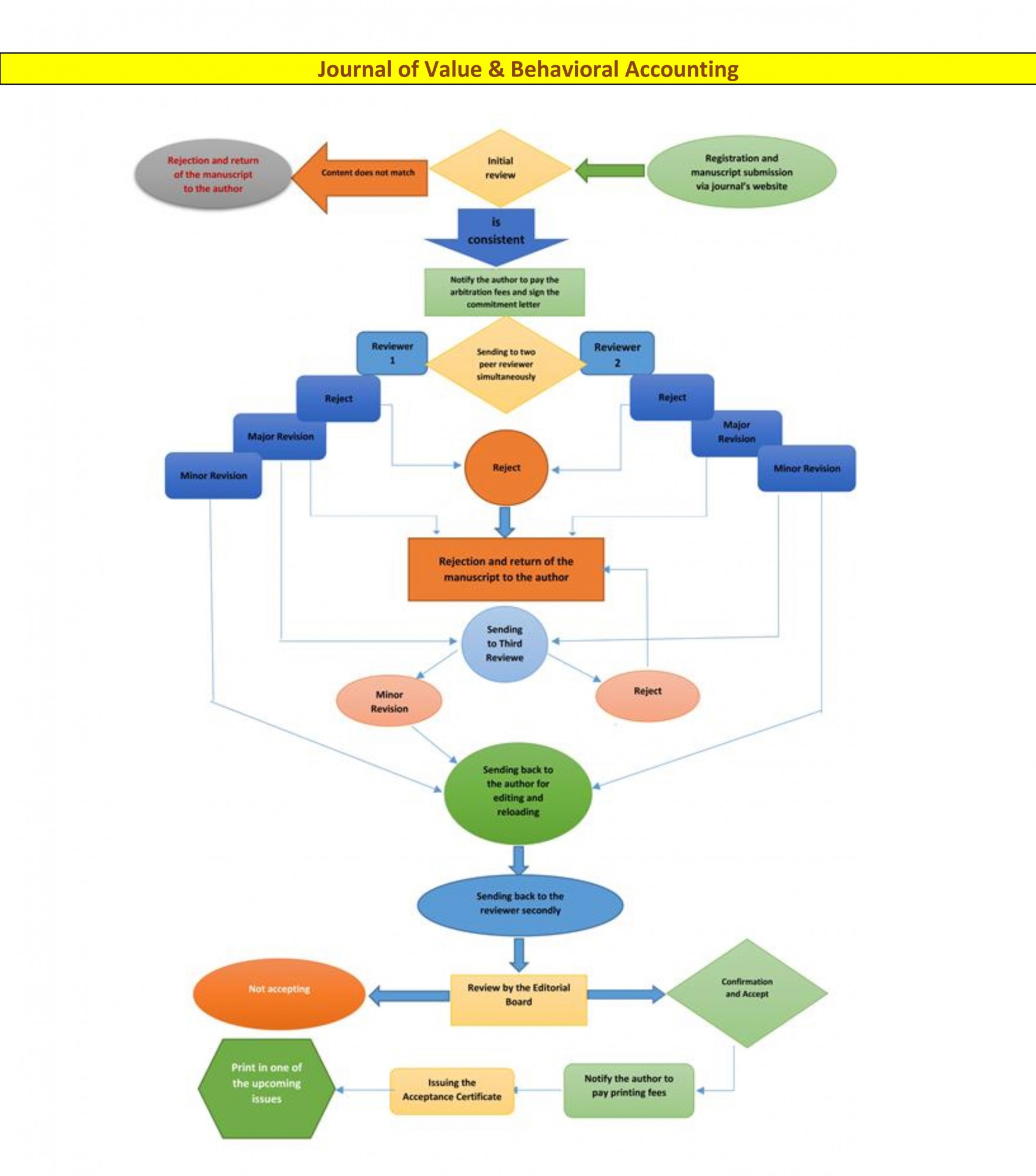
  • Diagram of the Acceptance Process in journal of Value & Behavioral Accounting
  • Copyright: Journal allows the author(s) to hold the copyright without restrictions. 
  • CC BY-NC-ND 
    This license allows others to download the works and share them with others as long as they credit them, but they can’t change them in any way or use them commercially.


Current Issue: Volume 10, Issue 20, September 2025 

Keywords Cloud

  • Corporate social responsibility
  • professional skepticism
  • Auditors
  • Auditing
  • professional ethics
  • Theory of Planned Behavior
  • Accounting
  • Forensic accounting
  • machiavellianism
  • Fraud
  • Corporate Governance
  • Grounded theory
  • Audit Quality
  • Social responsibility
  • Thematic analysis
  • Auditor
  • Whistleblowing
  • Locus of control
  • Earnings management
  • Sustainability Reporting
  • Audit
  • Information Asymmetry
  • Environmental Reporting
  • Professional judgment
  • professional commitment
  • Fraud Risk Assessment
  • Meta-synthesis
  • Content analysis
  • Signaling Theory
  • behavioral accounting
  • Financial reporting
  • professional identity
  • Iran
  • Tax Avoidance
  • Islamic accounting
  • Scenario Planning
  • Stock Price Crash Risk
  • job performance
  • Asymmetric cost behavior
  • sustainable development
  • Financial Performance
  • Social Trust
  • Whistle Blowing
  • role ambiguity
  • Greenwashing
  • managers\' overconfidence
  • Subjective norms
  • Ethical accounting decision making
  • Iranian Association of Certified Public Accountants
  • Phenomenology
  • Organizational Citizenship Behavior
  • Audit Committee
  • Future Study
  • Reporting
  • Auditing profession
  • professional performance
  • self-efficacy
  • stress
  • Corporate Social Responsibility (CSR)
  • Accountability
  • Firm performance
  • Social identity theory
  • Ethics
  • Corporate sustainability
  • tax evasion
  • Fraud Triangle
  • Social capital
  • Systematic Risk
  • Readability of financial reporting
  • Cognitive dissonance
  • Cost stickiness
  • Cost of equity
  • Financial Reporting Quality
  • Financial Managers
  • Managerial Ability
  • Corporate Culture
  • Social Dominance
  • Ethical leadership
  • Personal Moral Philosophy
  • Internal Audit
  • Accounting Students
  • Motivation
  • Theme Analysis
  • Social status
  • Accruals
  • Islamic Financial Reporting
  • Psychological well-being
  • Firm Value
  • Fraudulent Financial Reporting
  • Auditor Judgment
  • Religious Beliefs
  • Stakeholders
  • Family firms
  • Decision making
  • Audit profession
  • Meta-analysis
  • Emotional Intelligence
  • Organizational Identity
  • Economic Dimension
  • modesty
  • Labor investment efficiency
  • behavioral biases
  • Board Expertise
  • Perceptual Justice
  • Bibliometric
  • Machiavellian ism
  • Managers\' Myopia‌
  • Social Ethics
  • Behavioral Features and Auditor
  • Social Pressure Anomie
  • Behavioral Commitment
  • Involvement
  • Financial Transparency
  • curriculum
  • Audit effort
  • corporate governance.corporate sustainability accounting
  • Investment Intentions
  • Number of Total Restriction Paragraph
  • Behavioral Characteristics of the Company
  • information technology
  • Unethical Reporting
  • Labor Quality
  • Gender diversity of auditors
  • faith theory
  • Fraud Pentagon Model
  • Auditor Dysfunctional Behavior and Audit Quality
  • Unsystematic Risk
  • Metacognition
  • Fuzzy Delphi
  • Linear and Nonlinear Brain Functions
  • social networks analysis
  • anomaly detection
  • Perception of Fairness and Whistle-blowing
  • Form of Financial Iinformation Presentation
  • Professional Skeptics Auditors
  • Sustainability
  • Individual Risk-taking
  • key audit matters
  • Youth Religious Behavior
  • Socio-Emotional Wealth Perspective
  • Trait Professional skepticism
  • Individual Mechanisms
  • Agency theory
  • Working Capital Adjustment Rate
  • financial leverage
  • Supreme Audit Court
  • selective information disclosure
  • symbolic behavior
  • Environmental and Social and Corporate Governance Reporting (ESG)
  • Ethics Real Earnings Management
  • Mixed Methods (Quantitative and Qualitative Methods)
  • Individual Morality
  • continuous learning
  • thinking style
  • Government Ownership
  • Social Factors
  • Metasynthesis
  • citizenship behavior
  • Stock price informativeness
  • Sociolinguistics
  • Ownership of Board Members
  • Auditor Gender
  • Earning Management
  • Philosophic - Mindedness
  • formal sanctions
  • Professional Socialization
  • Audit Fee Dependence
  • formal surveillance
  • Managers\' Cash Bonus
  • board members
  • CEO duality
  • Reading Patterns
  • Return on Assets
  • Non-Paternal Behavior
  • Performance Capability
  • Auditors Working in Auditing Organization
  • Propensity to Cheat
  • external source of control
  • external transparency
  • Rules-Based Accounting
  • Moral Outrage
  • technology acceptance
  • Professional Skepticism (PS)
  • Income Tax
  • Neo Big Five Traits
  • Ethical Decision-making of Accountants
  • Perceived Moral Intensity
  • Topics in Environmental Biology
  • Individual Organizational Behavior
  • Perceived Partner Support
  • Analytic Hierarchy Process (AHP)
  • Importance-Performance Analysis
  • Bystander Effect
  • Scandal
  • Conditional Conservatism
  • Performance of Iranian Audit firms
  • Ethical Predispositions
  • Firm’s Perceived Support
  • Creative Corporate Culture
  • Saw Method